Fermor Connection to Shakespeare

In “Merry Wives of Windsor,” did William Shakespeare satirize Sir Thomas Lucy, a great grandson of Thomas Richards alias Fermor?

Justice Shallow

Written sometime between 1596 and 1599, William Shakespeare’s Henry IV, Part 2, introduces the character of Robert Shallow, a tall, thin, elderly, and wealthy landowner and Justice of the Peace in Gloucestershire. As the story is told, Justice Shallow is raising a troop to fight against the rebellion in the north and meets with his old friend, Sir John Falstaff, a character introduced in Henry IV, Part 1. The scenes of the two gentlemen provide comedic relief to the drama.

Shallow reappears in Act I, Scene 1 of The Merry Wives of Windsor, and in the first twenty-four lines, Shallow, Slender, and Sir Hugh Evans discuss their coat of arms:

SHALLOW Sir Hugh, persuade me not. I will make a Star-Chamber matter of it. If he were twenty Sir John Falstaffs, he shall not abuse Robert Shallow, Esquire

SLENDER In the county of Gloucester, Justice of Peace and Coram.

SHALLOW Ay, Cousin Slender, and Custalorum.

SLENDER Ay, and Ratolorum too; and a gentleman born, Master Parson, who writes himself “Armigero” in any bill, warrant, quittance, or obligation— “Armigero!”

SHALLOW Ay, that I do, and have done any time these three hundred years.

SLENDER All his successors gone before him hath done ‘t, and all his ancestors that come after him may. They may give the dozen white luces in their coat.

SHALLOW It is an old coat.

SIR HUGH The dozen white louses do become an old coat well. It agrees well, passant. It is a familiar beast to man and signifies love.

SHALLOW The luce is the fresh fish. The salt fish is an old coat.[1]

Shallow then meets with Falstaff who accuses Shallow of killing his deer. With a story about stealing deer and the subsequent trial, threatened imprisonment, and a move to London, there is a belief that Shakespeare intentionally satirized Sir Thomas Lucy in the character of Justice Shallow. The opening conversation about the Lucy coat of arms, “three luces hauriant argent,” further reinforces the controversy.

Sir Thomas Lucy

Sir Thomas Lucy, the son of Sir William Lucy and Anne Fermor, with his long tenure in Warwickshire politics and as Justice of the Peace, may have had some association with the Shakespeares. William Underhill, who married as his second wife Dorothy Hatton, the sister of Sir Christopher Hatton, owned a house at Stratford-upon-Avon that became home of John Shakespeare, William’s father.

An indenture executed on 30 May 1568 has William Clopton, Esquire, of the first part, and Sir Robert Throckmorton, Sir Thomas Lucy, Edmund Plowden, Esquire, and William Underhill, Esquire of Newbold Revel, of the second part.[2] While Underhill was of no relation to the persons comprising the second party of the deed, Sir Lucy after this date would be distantly related to Throckmorton and Plowden. Sir Robert Throckmorton was the son of George Throckmorton and Catherine Vaux, the sister to Maud Vaux the wife Sir John Fermor. Sir Robert’s brother, Sir Nicholas Throckmorton, married Anne Carew, and their son, Sir Arthur Throckmorton, married Anne Lucas, the daughter of Sir Thomas Lucas and Mary Fermor, the daughter of Sir John Fermor and sister to Anne Fermor, Sir Thomas Lucy’s mother. Edmund Plowden was the father of Edmund Plowden and another son Francis Plowden who was married to Mary Fermor, the daughter of Bridget Bradshaw and Thomas Fermor of Somerton, the brother to Sir John Fermor. Clopton’s grandmother was Joyce Horde whose niece Frances Horde married Thomas Fermor of Somerton.[3]

It is likely that Sir Thomas was not a well-liked person, but he was respected. As justice, he was obligated to enforce a Parliamentary act in 1581 to keep citizens obedient to the state religion, with new penalties and instituting commissions very unpopular with Catholics. His association with and execution of orders from Robert Dudley, 1st Earl of Leicester, portrayed Sir Thomas as exceedingly harsh with recusants.

In 1591, John Shakespeare’s name was included in a list of recusants sent up to the Privy Council by Sir Thomas, with a second certificate signed on 25 September 1592. It has been argued if this “John Shakespeare” of Stratford-upon-Avon was the bard’s father. Evidence suggests that he was not, but rather another John Shakespeare who was a widower, Master of the Shoemaker’s Company, and who disappeared from town immediately after the list was submitted. As a widower, it would explain why the name of William’s mother was not listed on the recusant certificate.[4]

William Shakespeare: Poacher?

Perhaps the first mention that gives the “direct” association is from the early eighteenth century, and possibly earlier from the late seventeenth century. The story first related by Reverend Richard Davies, the rector of Saperton, Gloucestershire, and Archdeacon of Lichfield who died in 1708, was added to Reverend William Fulman’s biographical manuscript, and then documented in Nicholas Rowe’s The Dramatic Works of William Shakspeare (1710).

Egan, James. William Shakespeare before Sir Thomas Lucy for Shooting his Deer (1834). National Portrait Gallery, London: NPG D41662. Mezzotint.

Much given to all unluckinesse in stealing venison and rabbits, particularly from Sr ___ Lucy, who had him oft whipt and sometimes imprisoned, and at last made him fly his native country, to his great advancement: but his revenge was so great that he is his Justice Clodplate, and calls him a great man, and that in allusion to his name bore three louses rampart for his arms.[5]

He had, by a misfortune common enough to young fellows, fallen into ill company, and amongst them, some that made a frequent practice of deer-stealing, engaged him more than once in robbing a park that belonged to Sir Thomas Lucy, of Charlecote, near Stratford. For this be was prosecuted by that gentleman, as he thought, somewhat too severely ; and, in order to revenge that ill usage, he made a ballad upon him. This, probably, the first essay of his poetry, is said to have been so very bitter, that it redoubled the prosecution against him to that degree, that he was obliged to leave his business and family in Warwickshire, for some time, and shelter himself in London…[6]

Nothing is known of the ballad, but a few popular songs were attributed to Shakespeare. Joshua Barnes, an English scholar, heard an old woman singing a song during his stay at an inn sometime between 1687 and 1690. He paid the lady with a new gown, and she sang the first two stanzas, of which she could only remember from the song’s entirety.

Sir Thomas was so covetous
To covet so much deer
When horns enough upon his head
Most plainly did appear

Had not his worship one deer left?
What then? He had a wife
Took pains enough to find him horns
Should last him during life.[7]

The English Shakespearian critic, Edward Capell, came into the possession of another poem from a Mr. Jones who was born in 1613 near Stratford-upon-Avon and written in his old age, and Capell allegedly added the first two lines giving it more association to Sir Thomas.[8]

A parliament member, a justice of peace,
At home a poor scarecrow, at London an asse;
If lousie is Lucy, as some volke miscalle it,
Then Lucy is lousie whatever befall it.
He thinks himself greate,
Yet an asse in his state,
We allow by his ears, but with asses to mate.
If Lucy is lowsie, as volke miscalle it,
Sing lowsie Lucy, whatever befall it.[9]

That Shakespeare and Sir Thomas had some minor animosity with each other may be based on some truth, but the amount of speculation and embellishment has obscured what is fact, and what is fiction. While Sir Thomas did introduce a Parliamentary bill “for the better preservation of game and grain” in March 1585, his deer park was in Worcestershire on his wife’s inherited property, almost fifty miles away from Charlecote and Stratford. He never owned a deer park and no chancery record in Stratford, Warwick, or the Star Chamber chronicling Lucy’s prosecution of Shakespeare for deer poaching can be found, although a Star Chamber case was prosecuted by his son in July 1610 eight years after the play was written. In 1828, the owner of Charlecote told a story to Sir Walter Scott that the incident occurred at Sir Thomas’ deer park at Fulbroke, of which Sir Lucy did not own, although it was acquired by Sir Thomas’ grandson.[10]

Coat of Arms

Twice, the opening lines of The Merry Wives of Windsor has the number of fish on the coat of arms as twelve, which supposedly is the best evidentiary proof; however, the Lucy shield had three luces.

Source: https://archive.org/details/antiquitiesofwar00dugd/page/400/mode/2up

Other families, like Way and Geddes, also had a coat of arms with three luces, and the Company of Stock Fishmongers were of “two luces in saltire argent.” Shakespeare may have been humorously pointing out “partible differences” between a coat with two fish, three fish, or twelve fish, a phrase the heralds used when describing their objections when granting the coat of arms to John Shakespeare on 20 October 1596. The acting copy of The Merry Wives of Windsor is taken from the Folio Edition of 1623 and the dialog about the coat of arms may have been added as there is no mention in the publications from 1602 to 1619.[11]

Shakespearian scholars and critics generally argue and agree that William did not cast his “nemesis” as a caricature in two of his plays, and strongly suggest Justice Shallow is William Gardiner, a Member of Parliament on bad terms with Francis Langley, the proprietor of the new Swan Theater. Gardiner first married Frances Wayte, the widow of Edmund Wayte, whose son, William Wayte, “swore the peace” against Shakespeare and Langley to appear in court on 29 November 1596.[12]

Be it known that William Wayte craves sureties of the peace against William Shakspere, Francis Langley, Dorothy Soer wife of John Soer, and Anne Lee, for fear of death and so forth. [Writ of] attachment [directed] to the Sheriff of Surrey, returnable on the eighteenth of [St.] Martin.[13]

And the coat of arms? Frances Wayte was the daughter of Robert Lucy, Gentleman, whose coat of arms bearing three luces haurient was quartered on Gardiner’s shield.

Source: https://archive.org/details/in.ernet.dli.2015.501331/page/n109/mode/2up

Another compelling theory starts with the idea that William Shakespeare never wrote the play, and that the true playwright was Edward de Vere, 17th Earl of Oxford. Edward was the only son of John de Vere, 16th Earl of Oxford and Margery Golding. When John died in 1562, Edward at the age of two became a ward of Queen Elizabeth and was sent to live with Sir William Cecil whose daughter, Anne, became Edward’s first wife when she was fourteen. Anne had originally been pledged to poet, courtier, and scholar Philip Sidney two years earlier, until Sidney’s father, Sir Henry Sidney, backed out of the marriage negotiations. Sir Henry’s wife was Mary Dudley, daughter of John Dudley, 1st Duke of Northumberland, and they had another son, Robert Sidney. Robert and Edward were both quick-tempered members of Parliament and always at odds with each other, with one infamous argument occurring during a tennis match in full view of the French ambassadors. During the argument, Edward called Robert a “puppy,” and Robert retorted, “Puppies are gotten by dogs, and children by men.” As the argument escalated, Robert stormed off the court and challenged Edward to a duel. Queen Elizabeth intervened rebuking Robert of the “difference in degree between Earls and Gentlemen, the respect inferiors out to their superiors…” commanding him to call off the forbidden duel.[14] This incident may have been portrayed in Act 2, Scene 1 of Hamlet when Polonius references a “falling out at tennis.”

John Dudley’s lands had been attained for his role in preventing the ascension of Mary I. After losing the Duke of Northumberland title before his son could inherit it, Robert could not display his father’s earlier coat of arms consisting of twelve luces, the number of fish on the shield as mentioned in The Merry Wives of Windsor. This explanation would associate Shallow as Robert who replies, “It is an old coat.”[15]

Philip Farmer is the author and publisher of “Thomas Fermor and the Sons of Witney” tracing the family history from 1420 to 1685, and “Edward Farmar and the Sons of Whitemarsh” following their 1685 arrival from Ireland into Pennsylvania, North Carolina, Virginia, Tennessee, and Harlan County, Kentucky.


[1] Shakespeare, The Merry Wives of Windsor, Act I, Scene 1, Lines 1-24.

[2] Howard, Miscellanea Genealogica et Heraldica, vol.1 (1874), p.42.

[3] Hord, Genealogy of the Hord Family (1898), p.22. John Horde (-1594) and Alice Bulkeley’s daughter Joyce Horde married Sir Edward Grey (1472-1528) of Enville, Staffordshire; their daughter Elizabeth Grey married William Clopton (-1560) and had issue, William Clopton.

[4] Stopes, Shakespeare’s Warwickshire Contemporaries (1907), pp.31-32.

[5] White, The Works of William Shakespeare, vol.1 (1893), p.xxxvii.

[6] Rowe, Life of William Shakspeare (1832), p.3.

[7] Levi, The Life and Times of William Shakespeare (1988), p.35.

[8] “Thomas Lucy and Shakespeare’s Lost Ballad,” StrangeHistory.net. 09 September 2017.

[9] Campbell, The Dramatic Works of William Shakspeare (1838), p.xx.

[10] Lee, “Lucy, Thomas,” Dictionary of National Biography, vol.34 (1885), p.249; Stopes, Shakespeare’s Warwickshire Contemporaries (1907), p.41.

[11] Stopes, Shakespeare’s Warwickshire Contemporaries (1907), pp.38-39.

[12] Hannigan, “Shakespeare Versus Shallow,” The Shakespeare Association Bulletin, vol.7 no.4 (October 1932), pp.174-182.

[13] Hotson, Shakespeare versus Shallow (1931), p.9.

[14] Looney, “ ‘Shakespeare’ Identified (1920), pp.294-297; Ward, The Seventeenth Earl of Oxford, 1550-1604, From Contemporary Documents (1928), pp.165-177.

[15] “Unpacking Merry Wives of Windsor,” ShakespeareOxfordFellowship.org. 07 October 1999.

John Farmer, Musician

Of the Thomas Richards alias Fermor family connections to Edward de Vere, 17th Earl of Oxford, one may be composer and musician, John Farmer.[1]

Although his pedigree is unknown, John may have been descended from Thomas Richards alias Fermor,[2] with a 27 March 1584 entry in the register of Merton College for a “John Farmer, Leic[estershire], [from] a gen[erous] f[amily], [age]18.”[3] John was still “in youth,” according to a eulogistic poem in Divers and Sundry Ways of Two Parts in one … upon one Plainsong, a collection of canons printed in 1591 and, like all of his canons, dedicated to “very good Lord and Master, Edward Devere Earle of Oxenford… [and his] judgement in Musicke.” The works consist of a series of examples of three-part counterpoint in different orders and seems to have attained considerable success.

Before Bevin’s time the precepts for the composition of Canon were known to few. Tallis, Bird, Waterhouse, and Farmer were eminently skilled in this more abstruse part of musical practice.[4]

The following year, John was a major contributor to Thomas East’s The Whole Book of Psalms. He not only set all the canticles and hymns – twelve in number – he set five of the psalms to tune in which the melody, generally the tenor but as this tune was set for two trebles, counter-tenor, and bass, was given to the counter-tenor immediately above the bass. English music historian, composer, and musician Charles Burney (1726-1814) speaking of these settings says,

The counterpoint is constantly simple, of note against note, but in such correct and excellent harmony as manifests the art to have been very successfully cultivated in England at that time.[5]

By February 1595 Farmer was in Dublin, having been appointed organist and master of the choristers at Christ Church Cathedral, succeeding Thomas Bateson, until 10 August 1596 when he became their vicar-choral. An unauthorized absence led to a reprimand in 1597, and he was ordered to return by 01 August on pain of dismissal.

1595. Feb. 10.— Yt ls ordered ye said daie by the Deane and Chapter that Mr. John Fermer shall have as Mr. of the children & organist for this yeare flfteene pounds Currant money of England ffrom Candelmas daie last (vizt.) of the Vicars 10s. and of Mr. Deane 20s. and of every Dignitie 10s. ster. and the rest the Proctor of the Church is to make upp.

1590. Aug. 10.— The said daie Robert Jordan resigned his Viccars Rownie in the Chapter house, and the same daie John Farmer was sworn Viccar Corrall in his place.

1597. July 18.— It is ordered that if Mr. John Fermer doe not return by the first of August 1597 that then all Excuses sett apart; — His place to bee voyd in this Church for depting the land without lycence.[6]

In 1598 he was presented to the living of Kilsheelan, partly in County Tipperary and partly County Waterford, although it is speculated he probably appointed a deputy to act on his behalf. By early 1599, when his The First Set of English Madrigals to Four Voices was published, he had moved to Broad Street, London. The collection consists of seventeen madrigals, sixteen of which are for four voices, and the seventeenth for eight voices. In the address, John claims to have…

…fitly linkt Musicke to Number, as each give to other their true effect, which is to make delight, a virtue so singular in the Italians, as under that ensign only they hazard their honour.[7]

One of the madrigals was titled Fair Phyllis I Saw Sitting All Alone, containing four voices and alternates between double and triple beat subdivisions.

Fair Phyllis I saw sitting all alone
Feeding her flock near to the mountain side.
The shepherds knew not,
they knew not whither she was gone,
But after her lover Amyntas hied,
Up and down he wandered
whilst she was missing;
When he found her,
O then they fell a-kissing

Another madrigal is the four-part mixed chorus titled You Pretty Flowers.

You pretty flowers that smile for summer’s sake,
pull in your heads before my wat’ry eyes
do turn the meadows to a standing lake,
by whose untimely floods your glory dies,
for lo, my heart resolved to moist’ning air,
feeding mine eyes, redoubles tear for tear.

Among the titles of other madrigals he wrote include, A Pretty Little Bonny lass and Take Time While Time Doth Last.

A pretty little bonny lass:

A little pretty bonny lass was walking
In midst of May before the sun ‘gan rise.
I took her by the hand and fell to talking
Of this and that, as best I could devise.
I swore I would, yet still she said I should not
Do what I would, and yet for all I could not.

Take time, while time doth last:

Take time, while time doth last,
Mark how fair fadeth fast,
beware if envy reign:
take heed of proud disdain;
hold fast, now in thy youth,
regard thy vowed truth;
lest when thou waxeth old,
friends fail and love grow cold.

In 1601 he contributed the madrigal “Fair Nymphs I Heard One Telling” to the collection The Triumphs of Oriana in honor of Queen Elizabeth.

Fair nymphs, I heard one telling,
Diana’s train are hunting in this chase.
to beautify the place,
The fawns are running,
The shepherds their pipes tuning,
To show their cunning.
The lambs amazed leave off their grazing,
And blind their eyes with gazing,
Whilst the earth’s goddess doth draw near your places,
Attended by the Muses and the Graces.
Then sang the shepherds and nymphs of Diana
Long live fair Oriana.

Philip Farmer is the author and publisher of “Thomas Fermor and the Sons of Witney” tracing the family history from 1420 to 1685, and “Edward Farmar and the Sons of Whitemarsh” following their 1685 arrival from Ireland into Pennsylvania, North Carolina, Virginia, Tennessee, and Harlan County, Kentucky.


[1] Compiled and edited from “Thomas Fermor and the Sons of Witney” with other primary publications:  1) Brown et al, British Musical Biography (1897), p.142; and 2) Dix, “John Farmer,” Grove’s Dictionary of Music and Musicians, vol.2 (1906), pp.11-12.

[2] If John Farmer is a descendant of Thomas Richards alias Fermor, it is most likely he would be the son of {7} Richard Farmer, member of the Mercers Company of London, the son of John Farmer, the son of Alice ___ and Thomas Richards alias Fermor. See also Farmer, “Thomas Farmer, Jamestown Adventurer:  His History, Descendants, & Ancestors,” Pioneers along Southern Trails, vol.3 (December 2009), p.6.

[3] Clark, Register of the University of Oxford, vol.2 pt.2 (1887), p.134; Ludwig, “John Farmer’s Sundry Waies:  The English Origin of Michael Maier’s ‘Alchemical Fugues’,” Furnace and Fugue: A Digital Edition of Michael Maier’s “Atalanta fugiens” (1618) with Scholarly Commentary. 2020.

[4] Dix, “John Farmer,” Grove’s Dictionary of Music and Musicians, vol.2 (1906), p.11.

[5] Dix, “John Farmer,” Grove’s Dictionary of Music and Musicians, vol.2 (1906), p.12.

[6] Dix, “John Farmer,” Grove’s Dictionary of Music and Musicians, vol.2 (1906), p.12.

[7] Dix, “John Farmer,” Grove’s Dictionary of Music and Musicians, vol.2 (1906), p.11.

The Portrait of Sir George Fermor

The new book “Thomas Fermor and the Sons of Witney” includes portraits of Sir George Fermor and wife Dame Mary Curzon auctioned by Sotheby’s from the Easton Neston estate sale. Or are they a £78,000 fraud?

(Edited from the ArtDaily and The Guardian articles with additional sources.)

In May 2005, Sotheby’s announced the auction sale of collected works from Easton Neston on behalf of the Lord and Lady Hesketh and the Trustees of Frederick Fermor-Hesketh, 2nd Baron Hesketh. The sale was held at Easton Neston, near Towcester, over three days, from Tuesday, 17 May to Thursday, 19 May, with viewing at the house days prior from Thursday, 12 May to Monday, 16 May.

Additionally, the 3,319-acre estate, its private racecourse, and the entire estate village of Hulcote – was for sale.

House and Estate Village

Easton Neston has been the seat of the Fermor-Hesketh family since 1535 with its purchase by Richard Fermor (d. 1552), grocer and merchant who made a large fortune trading with Flanders and Italy. He lived there in great style until his estates were forfeited in 1540. However, King Henry VIII relented at the end of his life, and the Fermors once again occupied Easton Neston.

The estate passed to Richard’s eldest son, Sir John Fermor, and then to his eldest son, George Fermor.  In September 1585, Robert Dudley, Earl of Leicester, set off to the Low Countries with a substantial army to fight the Spaniards. Fermor was part of this expedition and was knighted by Leicester in 1586. On 27 June 1603, Sir George and his wife Mary Curzon entertained James I and Anne of Denmark on their way south from Scotland to assume the Crown of England. There was an enormous gathering and it was reported that the countryside could “scarse lodge the infinit companie of lords and ladies and other people.” Ben Jonson composed a special poetical entertainment for the occasions. The new King knighted a number of those gathered at Easton Neston, including Sir George’s eldest son Hatton.

The present house is widely considered to be one of the most beautiful country houses in England. Described in William Camden’s Britannia (1586) as a “beautiful seat,” the original house there was an amalgam of Tudor pitched roofs, gables, arched doorways and mullioned windows. This same house was home to six generations until, in the 1690s, Sir William Fermor (1648-1711) decided to consult Sir Christopher Wren (his cousin by marriage) for advice on building a new house. Wren’s office designed two wings for a new house (one of which no longer exists) and directed Sir William to his highly talented colleague Nicholas Hawksmoor around 1700.

Large 500-Year Fine Art Collection

The large collection up for auction consisted of over 1500 items to include fine English and French furniture, old master and British paintings, tapestries, silver, books, chinese cloisonné, Japanese lacquer work, and European porcelain and glass representing centuries of patronage and collecting at the highest level.

“The collection of works of art at Easton Neston is one of the most significant to have been put together by a British family over the last five hundred years. The house is full of rare and beautiful objects that reflect the changing tastes and fortunes of nearly 20 generations of the Fermor-Hesketh family, and Sotheby’s is extremely honoured to have been chosen to conduct such an historic sale.”
Henry Wyndham, Chairman of Sotheby’s Europe

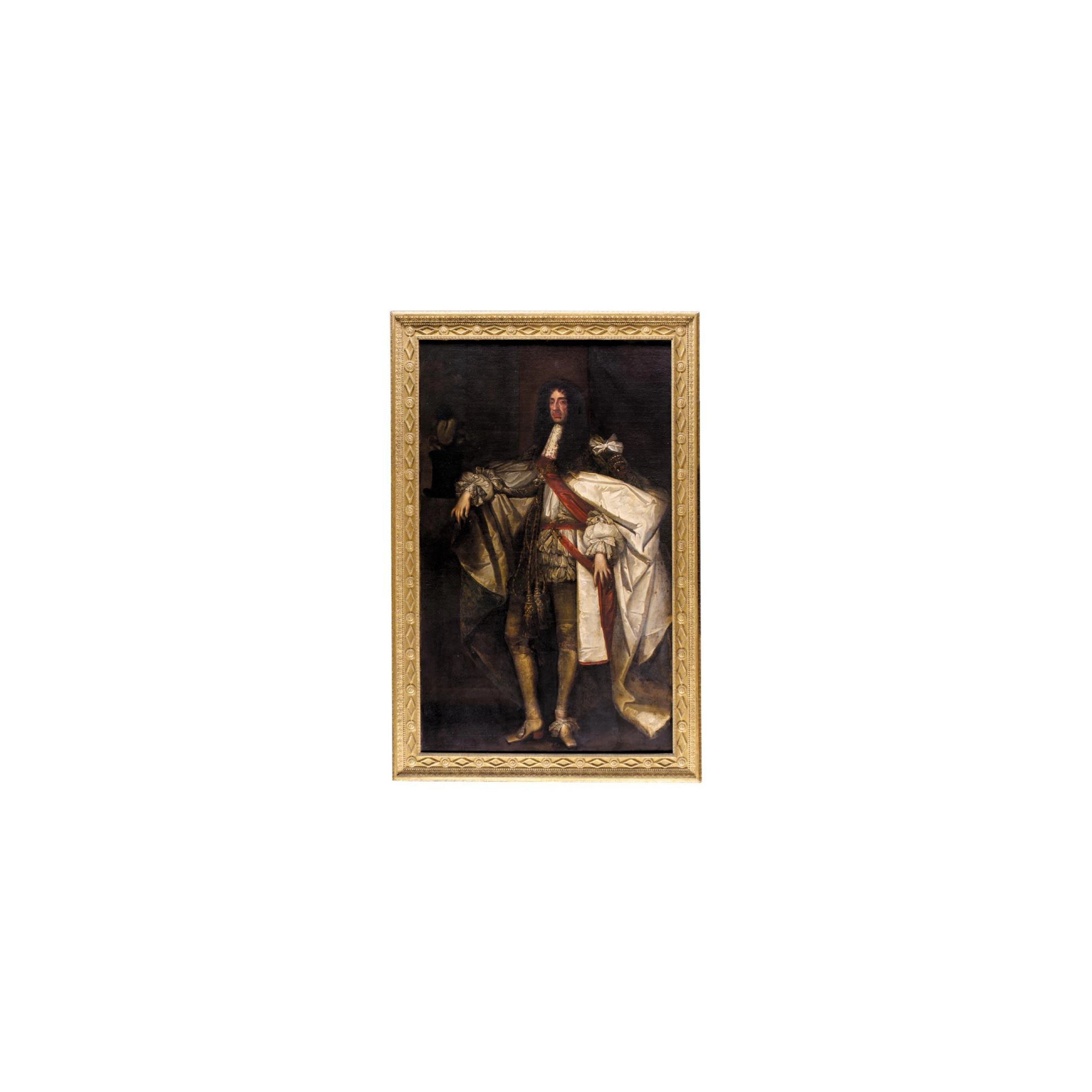
The collection also contains an impressive collection of Old Master Paintings. Largely amassed during the 18th and 19th centuries, these include works by Jan van Goyen, Joseph van Bredael, Joost Cornelisz Droochsloot, and Pieter de Bloot, as well as an interesting group of 17th-century Dutch and Flemish still-life paintings. Alongside is a splendid array of English portraits and a large group of family portraits by Sir Peter Lely and Sir Godfrey Kneller.

Lely, Sir Peter. Portrait of King Charles III. Sotheby’s, Easton Neston Sale, Lot #162. Oil on canvas.
Click here for more information.

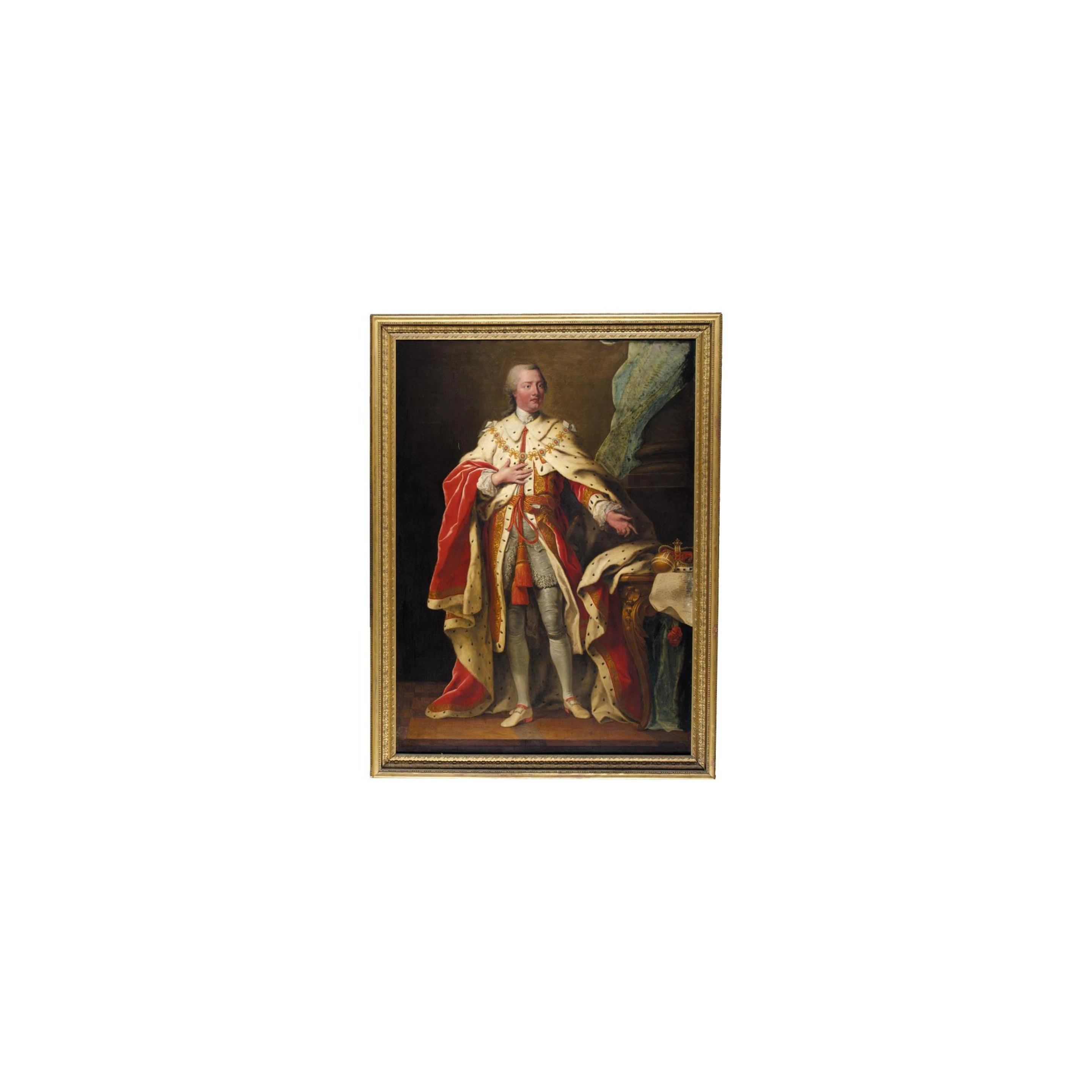
Later works include the full-length portrait of the Countess of Pomfret (est: £60,000-£80,000) by Sir Joshua Reynolds and an unpublished portrait of King George III attributed to John Shackleton, possibly presented to the 2nd Earl of Pomfret by the King himself. Further to the portraits, the sale will include a number of particularly good bird paintings by artists such as Peter Casteels.

Reynolds, Sir Joshua. Portrait of King George III. Sotheby’s, Sale at Easton Neston, Lot #163. Oil on canvas.
Click here for more information.

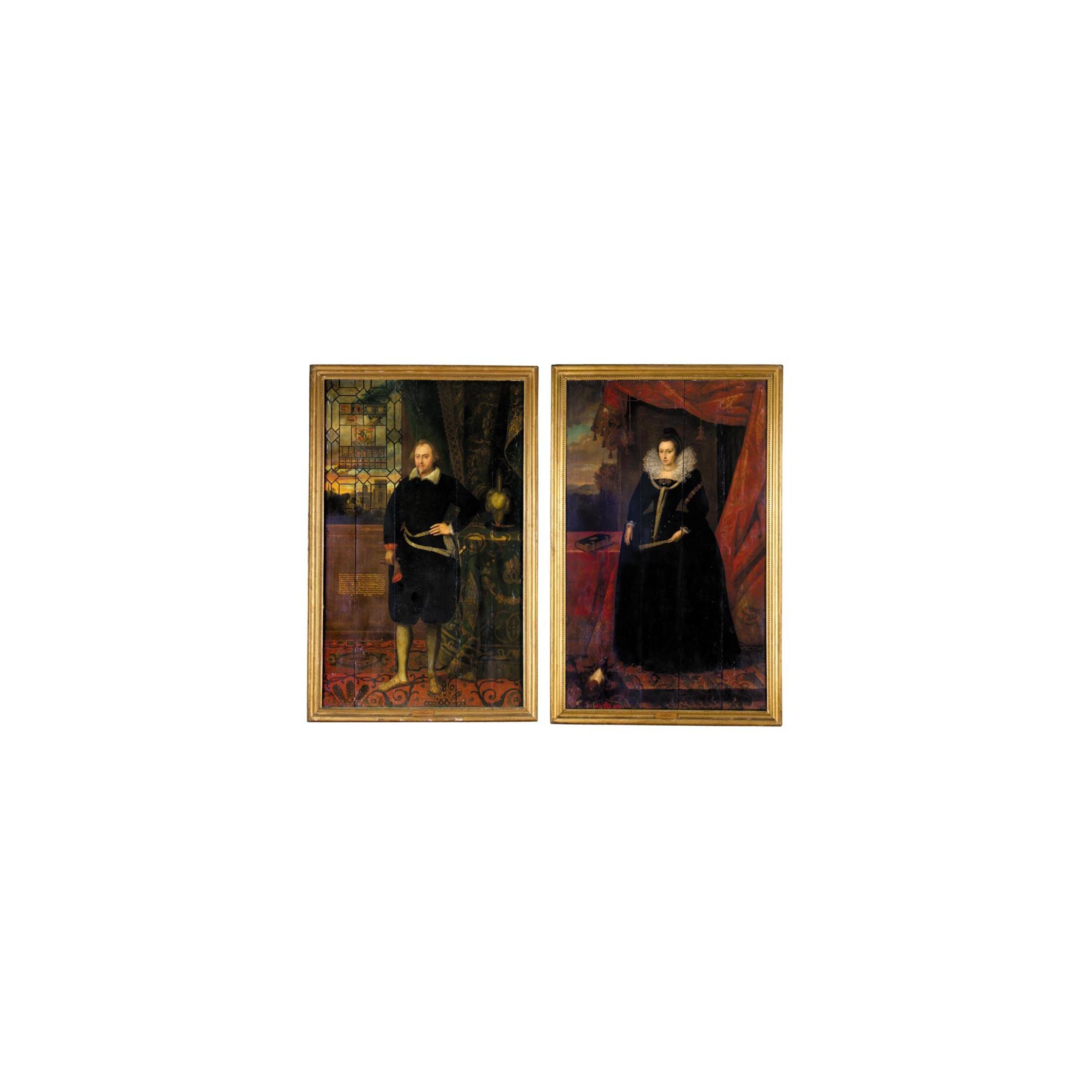
Among the paintings for sale are fine portraits of Sir George Fermor (d. 1612) and his wife Mary Curzon (d. 1628), both oil on panel measuring 264 by 140cm. (104 by 55in.) painted by (or attributed to) Robert Peake the Elder and extensively inscribed.

Unknown. Portrait of Sir George Fermor (and wife). Sotheby’s Sale at Easton Nest, Lot #164.
Click here for more information.

Sr: Geo: Farmor of Easton Neston in yCounty of Northampton K:/ son & Heir of S:Iohn Farmor K:of yBath by Matilda his Wife, One of y/ Daughters of Nich: Vaux Bar:of Harowden by Anne his 2wife Daugh / Heirefs of The: Greene of Greenes = Norton in yCounty of Northampton Efq / And Grandfon of Rich: Farmor Efq who purchace’d yMannors of Eafton = Nef: / = ton and: by Ann his Wife Daughter & Heirefs of S:Will:Browne Knight / This S:George spent his Youth in yNeitherlands Fighting under yGreat / Captain William Prince of Orange ~ then Marrying lived w:th great Splen=/=der ~ Hofpitality at his Seat of Eafton where he had yHonour to enter=/=tain King Iames y1:and his Queen y1:time they ever met in England. / Aet:Ad:ri 1597

Controversy with Portrait of Sir George Fermor

The staggering array of treasures sold for a total of £8.7m. But a year later, there arose some additional controversy with the portrait of Sir George Fermor.

First, the head of British paintings at Sotheby’s, David Moore Gwyn, misdated the works when they were put into the auction, even though other experts claim to have seen “at first glance” that they were pastiches.

Art dealer Christopher Foley, one of many interested buyers and a specialist in 16th and 17th-century English paintings, visited before the sale.

“I viewed the pictures at Easton Neston carefully on behalf of the National Trust. I bought back on their behalf a number of pictures there which had formerly been in a Hesketh house in Lancashire and which is now National Trust. Both I and the trust’s art specialist dismissed the two [Fermor] portraits as wildly out of period at first glance. The painting technique was not remotely correct, the panels were of the wrong type of wood, the compositions of a style at odds with a dating to the late 16th century. They were obviously fanciful. I remember remarking to two other dealers at the time when standing in front of them that the cataloguing seemed absurdly optimistic.”

In the words of one respected dealer, “complete tat and worth a few grand at best as decoration.”

The general view is that the paintings were produced at some time in the 18th century, probably at the behest of a later Fermor who wished to have some grand-looking family portraits to give his pedigree a bit of class. “About as valid, chronologically, as getting Damien Hirst to paint the Duke of Wellington,” according to one dealer.

The works’ estimate at the time of the sale was £100,000-£150,000. But such were the doubts among specialist dealers that the buyer, fashion designer Jasper Conran, paid £78,000, thought to be the reserve price.

The paintings needed conservation work and the restorer began to doubt the pictures’ authenticity. The paintings were sent to Ian Tyers, a leading practitioner in the field of dendrochronology, a technique which can date with precision when a tree was felled by analyzing rings in a piece of wood.

“We were asked to look at the wooden panels on which these works were painted, which is something we are asked to do not uncommonly to verify what they are. In this case, however, our research unverified what they were. Our findings demonstrated clearly that they were not what they were sold as. The panels are in fact early 18th century – not, in other words, what they were thought to be. They were sold as being by followers of Peake, dated to around 1580 or 1590. The trees from which the panel were made were still growing then. My sense is that many people in the trade knew what they were all along.”

Return to Sale

Conran returned to Sotheby’s and after his money was reimbursed, the paintings quietly reappeared in another Sotheby’s sale. There is no reference in the illustrated catalog that these are known to be 18th century, with an arguably, misleading description of “manner of Robert Peake the Elder c1551-1619″ arranged among earlier Elizabethan and Jacobean works… rather than chronologically with the 18th century paintings.

The portraits were to come under the hammer again on November 23, with an estimate of £40,000-£60,000. Mr. Foley believes that an estimate of £10,000 gives a more reasonable indication of their value.

“to call them ‘magnificent’, as they do in the new catalogue is, well, completely over the top – and the new estimate of £40-£60,000 seems, shall we say, rather enthusiastic for a pair of 18th century pastiches in very fragile condition.”

Challenged on the description of the works, Gwyn said that “in the manner of” gave a clear indication of the works’ date: “If you look it up in the glossary you will see that it is our way of saying ‘painted at a later date’.”

Asked about the apparent failure of the catalog to make clear that the works are now the property of Sotheby’s, Gwyn pointed out that a triangle-shaped symbol in the paintings’ catalogue entry signified “property of Sotheby’s” – again, a definition available by reference to a glossary.

Asked about the omission of the real date of the works, he said:

“This is our normal format. It has been like this for 30 years. To anyone who asks me, I say they are 18th century. We are not intending to deceive in any way. I am happy to put up a note next to the painting [in the auction house] saying they are 18th century. I agree that maybe some people won’t know what ‘in the manner of’ means.”

As for the estimate, he said: “Well, I don’t know: we’ll have to see. Estimates are only estimates, and they come from one’s experience.”

“We’re not perfect,” Gwyn told the Guardian. “We do our best. I thought they were of the period.”

Philip Farmer is the author and publisher of “Thomas Fermor and the Sons of Witney” a 790-page biographical history of the Fermors from 1420 to 1685. Another book “Edward Farmar and the Sons of Whitemarsh,” follows the family immigration from Ireland into Pennsylvania, North Carolina, Virginia, Tennessee, and Harlan County, Kentucky.

Click here for more information

325th Anniversary

In 1698, Edward Farmar donated land and built a log cabin for the purposes of a church.

For 325 years, St. Thomas’ Episcopal Church, Whitemarsh, has supported the community’s spiritual and social needs.

It’s an honor and privilege to kick-off their anniversary celebration with an invitation to speak at their inaugural event.

Hope to see you there!

War of the Three Kingdoms

The War of the Three Kingdoms ended with the English declaring their independence from the monarchy, and the descendants of Thomas Fermor had a role in history. Excerpted and edited from the book “Thomas Fermor and the Sons of Witney.”

Americans will celebrate their Independence Day holiday with fireworks as the date English subjects of the Crown declared a government ruled by the people for the people. The resulting Revolutionary War would see William Farmar Deweese playing a role in sheltering General George Washington’s troops at Valley Forge during the winter of 1777-78.

It was not the only time the English declared their independence in similar fashion from the monarchy that would see other descendants of Thomas Fermor with a role in history.

Click image to enlarge

Young Duke of Albany visits Sir George Fermor

At the age of three, Prince Charles, the Duke of Albany, reunited with his parents King James VI & I and Anne of Denmark at the home of Sir George Fermor in Easton Neston, Northamptonshire.

The summer after [1604], my Lord Dunfermline and his lady [Grizel Leslie, Seton’s second wife] were to bring up the young Duke. The King was at Theobalds, when he heard that they were past Northumberland ; from thence the King sent me to meet them, and gave me commission to see them furnished with all things necessary, and to stay with them till they had brought the Duke to court. I did so, and found the Duke at Bishops Awkeland. I attended his Grace all his journey up ; and at Sir George Farmor’s (Eaton), in Northamptonshire, we found the King and Queen, who were very glad to see their young son.

There were many great ladies suitors for the keeping of the Duke but when they did see how weak a child he was, and not likely to live, their hearts were down, and none of them was desirous to take charge of him.

After my Lord Chancellor of Scotland and his lady had stayed here from Midsummer till towards Michaelmas, they were to return to Scotland, and to leave the Duke behind them. The Queen (by approbation Of the Scotch Lord Chancellor) made choice of my wife [Elizabeth, daughter of Sir Hugh Trevanion], to have the care and keeping of the Duke [before 19 November 1604]. Those who wished me no good, were glad of it, thinking that if the Duke should die in our charge (his weakness being such as gave them great cause to suspect it), then it would not be thought fit that we should remain in court after. My gracious God left me not, but out of weakness he showed his strength, and, beyond all men’s expectations, so blessed the Duke with health and strength, under my wife’s charge, as he grew better and better every day. The King and Queen rejoiced much to see him prosper as he did… My wife had the charge of him from a little past four, till he was almost eleven years old in all which time, he daily grew more and more in health and strength, both of body and mind, to the amazement of many that knew his weakness, when she first took charge of him.[1]

Bankrupt King

On 27 March 1625, James died of dysentery, and Charles succeeded a nearly bankrupt monarchy due to his father’s extravagant spending on paintings and musicians to entertain his court.

In June 1625, Parliament granted the king the customs duties from tonnage and poundage for one year. Parliament had refused to grant funds to Charles I for his war with Spain until their concerns about his favorite, George Villiers, 1st Duke of Buckingham, had been addressed. When Christian IV of Denmark was defeated at Lutter in August 1626, Charles needed more funds to aid his uncle. He decided to bypass Parliament by levying a deeply unpopular Forced Loan without their consent. Many leading members of the gentry were appointed commissioners to collect monies, including Sir Richard Verney for Warwickshire. Some Members of Parliament were imprisoned for simply refusing to collect for the loan.

One of those arrested was Sir Nathaniel Barnardiston. For his persistence in refusing to contribute “the shipmoney, coal, and conduct money, and the loan,” he was “committed to prison, at first in the Gatehouse in London, and subsequently in a castle of Lincolnshire.” Five of the men arrested had attempted to bring a test case in November 1627 by suing out writs of habeas corpus. The judges refused to pass judgment, instead remanding the prisoners to custody after being informed by the Privy Council that they had been arrested on the orders of the king.

The Duke of Buckingham was financially restrained from sending a fleet to support the Siege of La Rochelle which had started on 10 September 1627. On 06 November, half of the English sent to fight the war in France were slain, including Richard Leigh. Charles needed more money and reluctantly summoned Parliament.

Parliament of 1628 & Personal Rule

Members returned for Parliament in 1628 were Sir Nathaniel Barnardiston (Suffolk), Thomas Wenman (Brackley), Sir Thomas Lucy (Warwickshire), Francis Lucy (Warwickshire), and James Fiennes (Oxfordshire).

As a gesture of goodwill, and in the hope of defusing some of the expected criticism, Charles ordered in January 1628 the release of those imprisoned for refusing to contribute to the Forced Loan. In March 1628, it was ordered by the king, being present in Council held at Whitehall, certain persons shall be “set at liberty from any restraint put on them by his Majesty’s commandment… Sir Nathaniel Barnardiston, John Hampden, Richard Knightley, &c.”[2] In the same month Sir Nathaniel was returned to Parliament as a representative of Suffolk and greeted with derision that “they would not have been chosen if there had been any gentlemen of note, for neither Ipswich had any great affection for them nor most of the country; but there were not ten gentlemen at this election.”[3]

Stone, Henry; Sir Thomas Wenman (1596-1665), Later 2nd Viscount Wenman; National Trust, Hartwell House; http://www.artuk.org/artworks/sir-thomas-wenman-15961665-later-2nd-viscount-wenman-217473

Once assembled, the House of Commons indicated that it would vote five subsidies in return for the king’s acceptance of a Petition of Right confirming the rights of the individual and protecting them against the divine right of the king. Parliament also mandated that the king could not arbitrarily imprison or levy taxes on his subjects without the consent of Parliament. After much debate and delay, Charles gave his assent to the Petition and the Subsidy Bill passed through its final stage in the House of Lords by 17 June 1628.

Parliament then turned its attention to the taxes of tonnage and poundage, which Parliament considered illegal. Charles brought the session to a rapid close. When Parliament reconvened in January 1629 it returned to the issue of tonnage and poundage, claiming that its continued imposition contradicted the Petition of Right. Matters got so heated that Charles dissolved Parliament by proclamation on 02 March 1629 and arrested nine of the leading protagonists, one of whom, Sir John Eliot, would die in the Tower of London three years later. Charles then dissolved Parliament in person on 10 March, starting the king’s “Personal Rule.”

The king’s finances between 1629 and 1640 were in a precarious condition. Tonnage and poundage, ship money, compulsory knighthood, revival of ancient forest laws, and meaner work by the Court of Wards were all employed to fill the treasury, but by July 1635 Charles was £1,730,000 in debt. With an incompetent government and economic troubles came unceasing demands for more money, fleecing the rich and oppressing the poor, while imprisoning the opposition without trial and then banishing them from their homes as punishment.

First & Second Bishop’s War

For many, Charles and Archbishop William Laud’s 1637 imposition of a new Prayer Book had too many similarities with Catholicism. Riots broke out in Edinburgh as the Scots viewed the royal decree as an attack on Protestantism and their freedom of worship. The Scottish Presbyterians signed a Covenant in 1638 before God to defend and preserve the true national religion.

Although they pledged their loyalty to the king, Charles saw their protests as an attack on his “divine” royal authority with punishments for those who refused the Prayer Book. The next year, Charles personally financed and sent an inexperienced army of twenty thousand to enforce the Prayer Book, thereby declaring war on his subjects. The English army was easily defeated in what is now known as the First Bishop’s War.

Parliament insisted on peace with Scotland, but Thomas Wentworth, Lord Deputy of Ireland, was recalled to England in September 1639 as Charles’ advisor and advocated for a vigorous war having seen the dangers of Irish Puritanism.

“Go on vigorously or let them alone… go on with a vigorous war as you first designed, loose and absolved from all rules of government, being reduced to extreme necessity, everything is to be done that power might admit… You have an army in Ireland you may employ here to reduce this kingdom.”

Charles’ defeat after the Second Bishop’s War forced him to sign the Treaty of Ripon in October 1640 stipulating that the Scottish army were to be paid £850 per day while they occupied northern England. To pay the stipend, Charles called for an assembly of Parliament so that he could make the request for more money.

“Short” Parliament of 1640

Along with Barnardiston who returned on 14 April 1640 for Suffolk, Wenman returned for Brackley, James Fiennes for Oxfordshire, and Sir Thomas Lucy for Warwickshire. Also returned were Sir Thomas’ brother Francis Lucy for Warwickshire, Fiennes’ brother Sir Nathaniel Fiennes for Banbury, and Sir Edward Leigh for Staffordshire. Sir Martin Lister was also returned for Brackley and his brother-in-law Arthur Goodwin for Buckinghamshire, having both married sisters Mary and Jane Wenman, respectively.

After an eleven-year absence, Parliament had a long list of grievances. Nathaniel Fiennes refused to profess their religious loyalty to the king and claimed they were not corresponding with the Scottish rebels.

If the King suspected their loyalty he might proceed against them as he thought fit ; but that it was against the law to impose any oaths or protestations upon them which were not enjoined by the law ; and, in that respect, that they might not betray the common liberty, they would not submit to it.[4]

Nonetheless, the “Short Parliament” was sent home three weeks after they assembled when Charles dissolved it for refusing the funds.

First English Civil War

The dispute between Charles and Parliament reached a crisis in the beginning of 1642. On 04 January, Charles entered the House of Commons with an armed escort of soldiers to arrest John Pym, John Hampden, Denzil Holles, Sir Arthur Haselrig, and William Stode, who having been tipped, were not present.

A week later on 12 January 1642, Thomas Lunsford, a fugitive outlaw appointed by the king to the position of Lieutenant of the Tower of London, was arrested for collecting troops in a plot to capture the magazine at Kingston-upon-Thames. His replacement at the Tower, Sir John Byron, was also questioned for the shipment of arms to Whitehall and the sheriffs of London under the command of Major General Philip Skippon placed a guard around the Tower to prevent the distribution of any arms and ammunition. The plot, whether it was real or imaginary, only stoked tensions around London against the king’s poor decisions and opinion that Charles would try any means possible to obtain money and seize complete power.

On 09 February, the House of Commons proceeded to nominate and recommend persons whom they desired to be entrusted with the militia of the kingdom. Nathaniel Fiennes was named for Oxfordshire, Greville for Warwickshire, and Henry Spencer, 1st Earl of Sunderland, for Northamptonshire. With Charles refusing every demand of the Parliament to limit or suspend his own powers over the militia, Parliament under Oliver Cromwell published their celebrated Militia Ordinance on 05 March appointing lieutenants of the counties to array and arm a militia. With any obedience to the ordinance usurping the king’s authority, Charles reinstated the outdated Commission of Array, and the summer was employed by Parliament’s “Roundheads” and the king’s “Royalist” forces making preparations for war.[5]

On 22 August 1642, Charles erected his Royal Standard at Nottingham demanding the extraordinary aid of his subjects. The king had officially and openly declared war.

The Second English Civil War

The war lasted for almost four years until the king escaped the Siege of Oxford in May 1646 disguised as a servant and fled to the Scottish Presbyterian army. One of the Royalists who fought alongside the king was Francis Plowden, the eldest son of Sir Edmund Plowden, who was earlier besieged in the Battle at Shiplake Court.[6] Francis was allowed to depart with his servants and horses.[7]

After nine months of negotiation and in exchange for £100,000, the Scottish Presbyterian army presented Charles to Parliament in January 1647, who promptly placed him on house arrest. With their king back in the country, the Royalists rose again in May 1648 to start the Second English Civil War.

Nathaniel Fiennes had supported several negotiations toward a settlement with Charles, losing patience when the king escaped to the Isle of Wight in November 1647. On parole, Charles I attended a conference on Newport, Isle of Wight, between 15 and 27 November 1648 in which Fiennes, his father William, and Thomas Wenman were appointed commissioners. Nathaniel sought a compromise between the factions of the civil war, opposing the radical position adopted by the army, and supporting Charles’s final answer to the Treaty of Newport.

With Parliament in negotiations with Charles, senior commanders of Cromwell’s New Model Army on 05 December 1648 took control of London to prevent any interference from the Scottish Covenanters and trained bands sympathetic to the Presbyterians. The next day under the command of Colonel Thomas Pride, soldiers appeared at the House of Commons and arrested one hundred forty Members of Parliament who were in opposition. Among those denied entrance in “Pride’s Purge” was Nathaniel Fiennes, James Fiennes, Sir Edward Leigh, Sir Martin Lister, and Thomas Wenman with the latter briefly imprisoned. The remaining Members of Parliament formed the Rump Parliament, with eighty-three voting to end negotiations. On 13 December 1648, Parliament annulled the treaty and by month’s end, several members were released.

Trial and Death of King Charles I

In January 1649, the Rump Parliament indicted Charles on a charge of treason and a trial began on 20 January. At the end of the five-day trial, the king was declared guilty and sentenced to death. Cromwell spelled out the warrant for his execution in a letter dated 29 January 1649 addressed to Colonel Francis Hacker, Colonel Hercules Huncks,[8] and Lieutenant-Colonel Robert Phaire, but both Phaire and Huncks did not sign the order for the executioner. Colonel James Temple of Surrey, the son of Sir Alexander Temple signed the death warrant.[9] Thomas Herbert as gentlemen of the bedchamber since 1647 was one of the king’s last attendants who accompanied the king to the scaffold.

Charles, who after traveling from Scotland as a sickly child to the home of Sir George Fermor at Easton Neston to be reunited with his parents forty-six years earlier, was beheaded at Whitehall on 30 January. Formal celebrations on the annual 05 November date commemorating the Gunpowder Plot had been suspended, but in 1649 after the king’s execution, the day was again celebrated with bonfires and miniature explosives.[10]

Philip Farmer is the author and publisher of “Thomas Fermor and the Sons of Witney” a 790-page biographical history of the Fermors from 1420 to 1685. The sequel “Edward Farmar and the Sons of Whitemarsh,” follows the family immigration from Ireland into Pennsylvania, North Carolina, Virginia, Tennessee, and Harlan County, Kentucky.

Click here for more information

[1] Seton, Memoir of Alexander Seton, Earl of Dunfermline, President of the Court of Session, and Chancellor of Scotland (1882), pp.199-200.

[2] Nichols, “The Institution and Early History of the Dignity of Baronet,” The Herald and Genealogist (1866), pp.210-211.

[3] Lee, “Barnardiston, Nathaniel,” Dictionary of National Biography, vol.3 (1885), p.243.

[4] Beesley, History of Banbury (1841), p.294.

[5] Beesley, History of Banbury (1841), p.298.

[6] Carter et al, “Sir Edmund Plowden and the New Albion Charter, 1632-1785,” The Pennsylvania Magazine of History and Biography, vol.83 no.2 (April 1959), p.151.

[7] Hamilton, The Chronicle of the English Augustinian Canonesses Regular of the Lateran, at St Monica’s in Louvain, vol.1 (1904), p.226.

[8] Hercules Hunck (b. ca. 1601, d. ca. 1677), son of Sir Thomas Huncks and Catherine Conway, and brother to Sir Henry Huncks (b. ca. 1595), Governor of Barbados (1640-1641) before his involvement with Providence Island. (Green, Calendar of State Papers, Domestic Series, 1654 (1886), p.377.)

[9] Prime, Some Account of the Temple Family (1887), p.12; Rylands, The Visitation of the County of Buckingham Made in 1634 (1909), p.212. Sir Alexander Temple was the brother of Mary Temple who was the wife of John Fermor of Marlow, and was the father of Susanna Temple, the second wife of Sir Martin Lister after the death of his first wife Mary Wenman.

[10] Ingram, “The Gunpowder Plot in Northamptonshire,” NeneQuirer.com. 26 October 2017.

Nicholas Fermor

The 1580 will of Thomas Fermor of Somerton gifts his “well-beloved nephew” Nicholas Fermor. Which one?

Per the 1580 will of Thomas Fermor of Somerton,

In default of such issue [of Mary or Richard, the children of Thomas], the remainder goes to my brother Jerome Farmor, according to the gift of my Uncle William Farmer of Somerton. If Richard dies without lawful issue, I give the Manor of Gannow and all [my other property] in Gannow, to my nephew Nicholas Farmer and the lawful heirs of his body…

I give a £10 pa life annuity to my well-beloved nephew Nicholas Farmor… But if and when he has acquired enough lands, tenements, annuities or fees, whether by descent, purchase, gift, grant, marriage or otherwise, to provide a clear income of £100 pa during his own or his wife’s life, the £10 annuity is to cease.[1]

Thomas also appoints his nephew George Fermor and his brother-in-laws Sir Richard Knightley, Richard Fiennes, and Sir Thomas Lucy as executors and overseers of his will. He mentions no other brother or sister.

In determining the identity of Nicholas Fermor, there are two options:  the son of Sir John Fermor, or the son of Jerome Fermor.

Nicholas, son of Sir John Fermor.

Sir John Fermor married Maud Vaux, daughter of Sir Nicholas Vaux. They had the following sons:  George; Nicholas; Richard; and Arthur.[2] According to Baker’s History and Antiquities of the County of Northampton (1844), Nicholas was still living in 1585 and died unmarried.

Baker’s inclusion of John’s fourth son Arthur also seems to refute the number of sons mentioned in the memorial of Sir John and Maud. It is most likely Arthur died very young and the memorial notes the number of surviving sons.

Here lie ye bodies of Sr John Farmor, of Eston Neston Knight of ye Bath and dame Maud his wife daughter of Nicholas Vaux Lord Harroden, they had 3 sonnes and three daughters and died, hee ye 20th of December MDLXXI & shee ye xivth of April MDLXIX.

Nicholas, son of Jerome Fermor.

Collins in his Peerage of England (1812) provides a synopsis of Thomas Fermor’s will and states that it “appears Nicholas Fermour, his nephew, was son of Jerome, his brother.”[3] Baker’s Northampton pedigree also indicates that Jerome and his wife Jane had issue, although none are mentioned.

If Jerome and Jane had a son Nicholas, he is not mentioned in Jerome’s 1602 will, nor Jane’s 1606 will. This may indicate that Nicholas died prior to 1602. Additionally, no mention of Nicholas is provided in the memorial to Jerome and Jane.

The memoriall of Heiro Farmore Esq. & Jane his wife they lived to-geath’r in Wedlock 42 Years, & he attended to ye honor of a great grand unckle & after 74 years left this home for a better Septb’r 7th Ao, 1602.[4]

So who is who?

One could argue that by only mentioning his brother Jerome, Thomas did intend to gift Jerome’s son Nicholas. Also, considering the verbose nature of the will, one could argue that Nicholas was married in 1580, and that Thomas did not mean should Nicholas marry. This points even further to Jerome’s son given the data above. Even the inclusion of “but if and when he has acquired enough lands, tenements, annuities or fees, whether by descent, purchase, gift, grant, marriage or otherwise” is interpreted as the time Nicholas has acquired land, not when he has married.

With Gervase Clifton, Esquire, son and heir apparent of Sir John Clifton of Bassington, Somerset, Nicholas Farmor of Hardwick assumed the £400 recusancy debt of Sir Thomas Tresham, Knight of Rushton, Northamptonshire, by a recognizance before the Exchequer barons dated 15 May 1592.[5]

A “Nicholas Farmor of Easton [Neston], co. Northampton, esquire” is mentioned in a 1594 indenture, along with Sir Richard Knightley, Sir Richard Fiennes, Valentine Knightley, Jerome Fermor, Richard Fermor “of Easton [Neston],” Sir Henry Darcy and “Dame Katheryn [Fermor] his wife,” Gabriel Pulteney, John Cope, and Thomas Thorneton.[6]

A “Nicholas Fermor, Gentleman” admitted to the Middle Temple on 02 July 1571 was most likely the son of Sir John.[7] If Jerome and Jane had married in 1560 per the calculations from their memorial, their son Nicholas would have been admitted at a minimum age of eleven.

Conclusion and further research

The conclusion is there were two nephews of Thomas Fermor named Nicholas. Jerome’s son Nicholas “of Hardwick” was gifted by Thomas and living in 1592. Sir John’s son Nicholas remained in Easton Neston and living in 1594.

Sir John and Maud may have named their child Nicholas after Maud’s father. Jerome and Jane’s son may have been named after Jane’s father and may provide insight into her identity whose coat of arms suggest she was from the Isacke family.

Philip Farmer is the author and publisher of “Thomas Fermor and the Sons of Witney” a 790-page biographical history of the Fermors from 1420 to 1685. The sequel “Edward Farmar and the Sons of Whitemarsh,” follows the family immigration from Ireland into Pennsylvania, North Carolina, Virginia, Tennessee, and Harlan County, Kentucky.

Click here for more information

[1] Hutchens, “Will of Thomas Farmor of Somerton,” Oxfordshire Family History Society (OFHS.uk). nd.

[2] Metcalfe, The Visitations of Northamptonshire Made in 1564 and 1618-19 (1887), pp.19-20; Baker, The History and Antiquities of the County of Northampton, vol.2 (1844), p.143.

[3] Brydges, Collins’s Peerage of England, vol.4 (1812) p.201.

[4] Baker, The History and Antiquities of the County of Northampton, vol.2 (1844), p.332.

[5] Bowler et al, Recusants in the Exchequer Pipe Rolls, 1581-1592 (1986), p.176.

[6] Lyte, A Descriptive Catalogue of Ancient Deeds, vol.3 (1900), p.199.

[7] Martin, “Minutes of Parliament of the Middle Temple (1501-1603),” Middle Temple Records, vol.1 (1904), pp.180, 182.

Jane (Isacke, Hunckes) Fermor

In determining the identity of Jerome Fermor’s wife Jane, the following information supplements what has been written in the new book Thomas Fermor and the Sons of Witney.

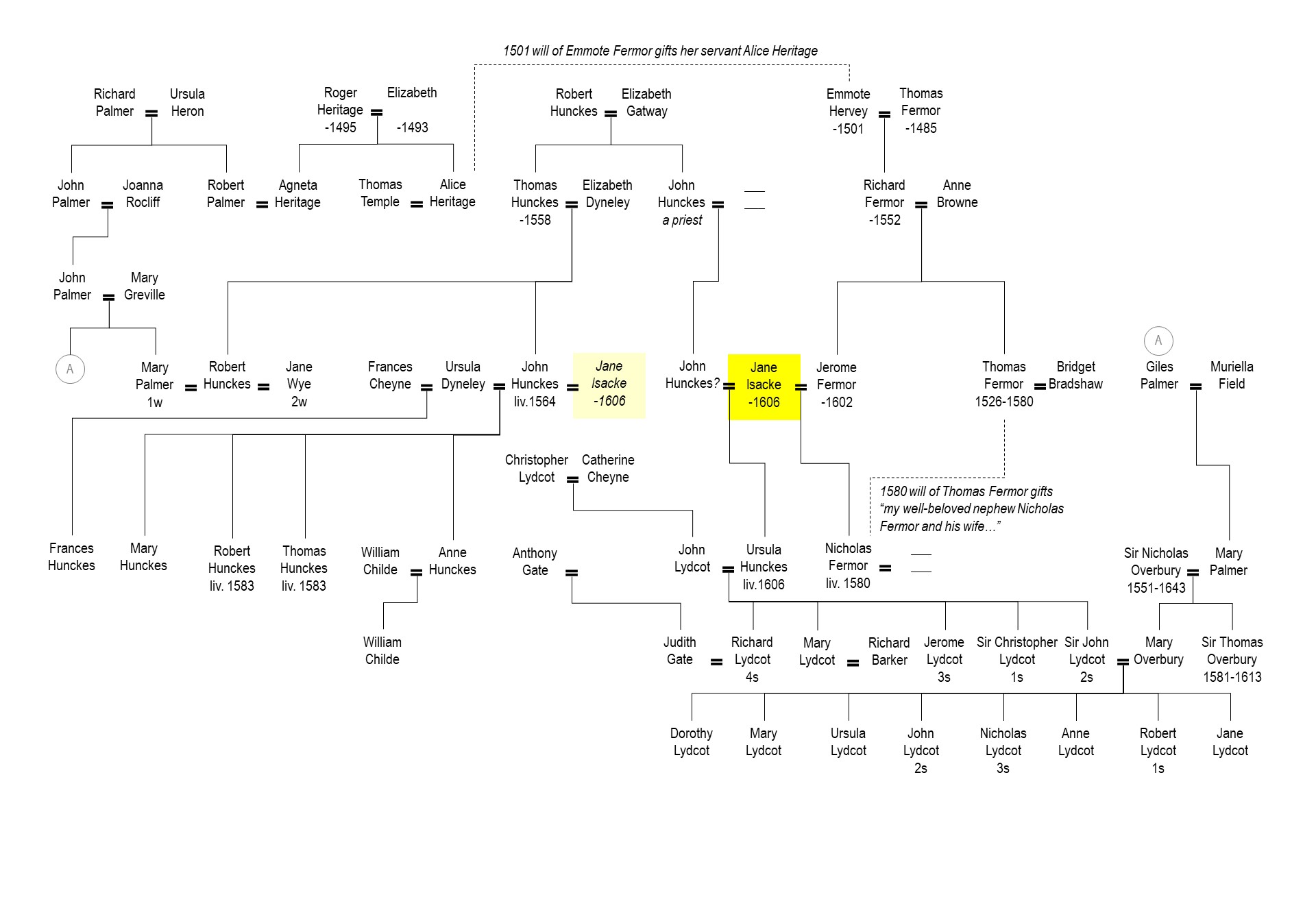
In the church at Towcester, Northamptonshire, is the memorial to Jerome and Jane Fermor who “lived togeath(er) in wedlock 42 years…” The coat of arms displayed above their kneeling effigies are of Fermor impaling Isacke.[1]

Jerome’s 1602 will bequeaths gifts to several nieces and nephews, yet provides no information to determine Jane’s identity.[2] Jane’s 1606 will names “my grandechildren John and Richard Lydcote” with John as “issue or eldest son of Ursula Lydcote, his mother, who was my only daughter…”[3]

Based on the county visitations of Buckingham, Berkshire, Surrey, and Oxford, John Lydcote married Ursula Hunckes and had issue Christopher, John, Jerome, Richard, and Mary.[4]

Ursula Hunckes is described as the daughter of John Hunckes. Per the 1569 visitation of Worcestershire along with other documentation, John Hunckes married Ursula Dyneley and Frances Cheyne, having issue with each wife.[5]

John Hunckes’ father Thomas died in 1558 seized of his Northwick property. Thomas’ eldest son and heir Robert settled the property in 1564 to his brother John. By 1583, John’s sons Robert and Thomas sold the property to their nephew William Childe, the son of William Childe and Anne Hunckes.[6]

When subtracting 42 years from Jerome’s death in 1602 or Jane’s death in 1606, their marriage calculates to sometime between 1560 and 1564. John Hunckes’ will probation and inquisition post mortem was conducted in 1572.[7] Either the memorial is incorrect, or Jane married a different John Hunckes.

It is more likely Jane Isacke married the son of John Hunckes, a priest who was brother to Thomas Hunckes (d.1558). This is based on the will of Thomas Fermor of Somerton who died in 1580. Fermor’s will gifts his brother Jerome and his “well-beloved nephew Nicholas and his wife…”[8] This timeline supports Jerome and Jane’s marriage in the 1560s.


If the pedigree is correct, Jane (Isacke, Hunckes) Fermor’s grandson John Lydcote married Mary Overbury, the sister to Sir Thomas Overbury who was poisoned to death in 1613 while imprisoned in the Tower of London.

Philip Farmer is the author and publisher of “Thomas Fermor and the Sons of Witney” a 790-page biographical history of the Fermors from 1420 to 1685. The sequel “Edward Farmar and the Sons of Whitemarsh,” follows the family immigration from Ireland into Pennsylvania, North Carolina, Virginia, Tennessee, and Harlan County, Kentucky.

Click here for more information

[1] See also:  MacKenzie, George Norbury. Colonial Families of the United States of America, vol.6 (1917), p.278.

[2] TNA PROB 11/100/291.

[3] TNA PROB 11/107/291.

[4] Rylands, The Visitation of the County of Buckingham Made in 1634 (1909), pp.177-178; Rylands, The Four Visitations of Berkshire (1907), pp.174-176; Bannerman, The Visitations of the County of Surrey Made and Taken in the Years 1530, 1572, and 1623 (1899), pp.199-200; Turner, The Visitations of the County of Oxford Taken in the Years 1566, 1574, and in 1634 (1871), pp.121-122.

[5] Phillimore, The Visitation of the County of Worcester Made in the Year 1569 (1888), pp.81-82. Note that the pedigree is incorrect in that there are two sons named John for Thomas Hunckes and Elizabeth Dyneley.

[6] ‘Parishes: Blockley’, in A History of the County of Worcester: Volume 3 (London, 1913), pp. 265-276. British History Online http://www.british-history.ac.uk/vch/worcs/vol3/pp265-276 [accessed 1 April 2022].

[7] TNA C 142/160/73; Index of Inquisitions Preserved in the Public Record Office, vol.2 (1963), p.191.

[8] Collins, Peerage of England (1812), p.201; Hutchens, “Will of Thomas Farmor of Somerton,” Oxfordshire Family History Society (OFHS.uk). nd. Abstract provided in Blomfield, History of the Present Deanery of Bicester, Oxon (1882), pp.11-12, with citation of “the MSS of Evelyn Philip Shirley, Esq., of Ettington Hall, Warwickshire, described in the Report of the Historical MSS Commission.”

Bibliography & Footnotes

The marketing for the new book “Thomas Fermor and the Sons of Witney” includes a statement that a full bibliography and footnotes are included. Why is this important?

There are good publications defined by the excellent, well-researched data they provide. There are also some publications with extremely poor data, and some genealogical books that contain “data” invented by fraudsters.

Other than the prevention of plagiarism, here are other reasons why references are very important.

Interpretation of Source Records.

Frederick George Lee (1832-1902) wrote about the relationship between the Fermors and the Wenmans in his book History and Antiquities of the Church of the Blessed Virgin Mary of Thame (1883). Lee makes a special note that he is correcting past genealogical mistakes, which may be the greatest argument in accepting his pedigree. This assumes Lee did not falsify his “findings” to increase book sales, as has been known to occur in recent history.

However, known source documents for the Fermor and Wenman relationships, at least up to 1501, do not support Lee’s assertions. Without the original source documentation used by Lee, the pedigree may be correct, although it does make the family tree messy with several assumptions. As the veracity of the Lee pedigree is inconclusive, it was included in the book to give it a wider audience who may be able to prove its accuracy.

Likewise, my interpretation of the source records may differ from the reader, and the source reference is included so that others may verify or refute the conclusions. My book “Edward Farmar and the Sons of Whitemarsh” created a little controversy. For years, family historians believed John Farmer was the father of Stephen Farmer of Harlan County and a chapter refuted this belief… complete with all bibliography and footnotes. Those same folks who sent the hate mail wrote months later to apologize after reviewing the source documents.

Traceability.

Have you researched your family tree by looking at another person’s family tree? You know that feeling you get when you question the validity of that tree because there are no source documents? For many family genealogists, the hallmark of any great family tree or a genealogical book is its original source documentation and traceability.

John Burke’s publications are an excellent start for genealogical research. Because Burke obtained the information from the families, the reliability can vary, especially as families contributed to one edition or publication, but not another, or contributed false information. This practice is very common with today’s digital genealogy and “open source” websites. As families died off, or no longer contributed, or as paragraphs were reduced to add more persons of interest, the earliest editions of Burke’s series provide better, more descriptive information. Note that Burke very seldom includes the reference to the source document.

Fraud Prevention.

There are instances in which a multitude of history books are written solely on the basis of outright false information from one source. Such may be the case with Jane Fermor, the daughter of Sir George Fermor, in which much of her maligned life originates from a discredited, unpublished “history” manuscript of scandalous falsehoods, and from an author of a family memoir who may have used it as inspiration, yet the information has been repeated in practically every history book since 1737.

The claim that Lady Jane (Fermor) Killigrew was a pirate may have begun with William Hals’ unpublished Compleat History of Cornwall, first started in 1685 and continued until 1736, until Hals died in 1737. The second part of his work was published in 1750 as Complete History of Cornwall, Part II being the Parochial History whereas the first part contained so many scandalous details that prevented its publication. However, Hals’ work did form the basis of Davies’ Parochial History of Cornwall together with additional efforts from Thomas Tonkins.

“There appears to be but little doubt that Hals was rather a scandalmonger, and also seems to have had some private grudge against the Killigrews, and in fact almost every other Cornish family, and the story has therefore been discredited by subsequent historians…”[1]

Likewise, being so very closely the same and with almost the exact same wording as George Calvert’s final petition for his colony in present Maryland, historians have suggested that Sir Edmund Plowden’s final petition for his colony of New Albion in present Maryland was a forged copy. Other research and evidence, including its location on two 1651 maps by Virginia Farrer (pictured above) and her brother John Farrer, have proven that his patent was not a fraud.

Mistakes.

Barnabas O’Brien married Mary (Fermor) Crichton, the youngest daughter of Sir George Fermor and Mary Curzon. Maurice Lenihan in his book Limerick; Its History and Antiquities (1884) incorrectly states he married “Mary, youngest daughter of Sir James [sic] Fermor, Knight, lineal descendant [sic] of the Barons Lempster, Earls of Pomfret…”[2]

Additionally, the Heralds’ visitations offer significant data for building family trees of ancestors from the sixteenth and seventeenth centuries. Supplementing their data with other documentation will sometimes show that even those pedigrees have errors or omissions. Have you noticed how some arguments in online genealogy chat forums originate from the use of one source without consideration that we’re all human and we all make mistakes?

The full bibliography and footnotes included in the book are tool and a key reminder for genealogists studying all pedigrees, family trees, and publications, to always verify… and then verify again.

Philip Farmer is the author and publisher of “Thomas Fermor and the Sons of Witney” a 790-page biographical history of the Fermors from 1420 to 1685. The sequel “Edward Farmar and the Sons of Whitemarsh,” follows the family immigration from Ireland into Pennsylvania, North Carolina, Virginia, Tennessee, and Harlan County, Kentucky.

Click here for more information


[1] Whitley, “Dame Killigrew and the Spanish Ship,” Journal of the Royal Institution of Cornwall, vol.7 no.27 (1883), p.283; Pearce, “Hals, William,” Dictionary of National Biography, vol.24 (1890), pp.123-124. For a reprint of Hals’ account, reference:  1) Whitley, “Dame Killigrew and the Spanish Ship,” Journal of the Royal Institution of Cornwall, vol.7 no.27 (1883), pp.282-283; & 2) Baring-Gould, Cornish Characters and Strange Events (1909), pp.135-137.

[2] Lenihan, Limerick; Its History and Antiquities (1884), p.157.

Barnabas O’Brien & Mary Fermor, Part 2

The O’Briens continued to live in Carlow Castle, but two years after moving into Bunratty Castle, they found themselves in the middle of a war in Ireland. Excerpted and edited from the new book Thomas Fermor and the Sons of Witney.”

On 17 July 1615, Barnabas “Barnaby” O’Brien married Mary (Fermor) Crichton, the youngest surviving daughter of Sir George Fermor, and the second great granddaughter of Thomas Richards alias Fermor.[1] George Carew in his letter dated 24 January 1616 to Sir Thomas Roe writes “August… Sir Brian Obrien, the Erle of Tomond’s second sonne, is married to the Ladie Sanquer.”[2] As Sir George had died on 01 December 1612 and was buried the next day, the widowed Mary (Curson) Fermor and her eldest son, Sir Hatton Fermor, arranged the marriage settlement.

Despite their home in the grand Carlow Castle, large estate, and beautiful Irish surroundings, Barnaby asked Sir Richard Boyle, Baron of Youghal (later first Earl of Cork), to meet him and Mary at Youghal so that “his wife think she is in England.”[3] In 1618, Barnaby and Mary were granted a license to operate several taverns in Carlow, as well as making and selling wine.[4] To Barnaby and Mary were born Henry and Penelope.

While intermarriage with English wives offered advantages to Irish nobles by increasing their social status, wealthy and well-connected English families were reluctant to send their daughters to a country associated with incivility, barbarism, rebellion, and popery. As a Catholic family, the main religion of Ireland would not have been a deterrent, and perhaps the firsthand accounts of life in Tipperary and Cork from Mary’s brother Robert were satisfactory. The marriages of English brides into the families of Irish nobles certainly facilitated family opposition to attempts by the government in the late 1630s to confiscate lands in Counties Kilkenny and Tipperary.[5]

After the 26 July 1639 death of Barnaby’s brother Henry O’Brien, 5th Earl of Thomond, Barnaby became the 6th Earl of Thomond and moved into Bunratty Castle, the Thomond family seat. The castle was “a noble ancient structure” and “the loveliest of any place of any kind [in Ireland]… worthy of a king” located on the banks of the River Shannon near Limerick. The large deer park allegedly held three thousand stags and the gardens were “the likes of which put Italy’s to shame.” The castle and its farm buildings were ordered and furnished, with two story stables holding up to sixty horses. The public rooms were furnished with great splendor. Eleven pairs of tapestries hung in the dining room, which could accommodate forty people seated around eight tables. A large Turkish carpet covered the floor. The master bedroom, dominated by a bed hung with dark orange velvet trimmed with gold and silver loops, and matching stools and cupboard cloths, also had rich Arras carpets and tapestries. The castle courtyard, with its kitchen, laundry and outhouses, was the hub of domestic activity.[6]

Shortly before Christmas 1641, a musket-wielding rebel force commanded by Sir Walter Bagenal and Sir Morgan Kavanagh besieged the town of Carlow. Almost four hundred Protestant English settlers sought refuge in Carlow Castle. After rejecting an offer of fair quarter and safe passage to the sea if they surrendered, they became virtual prisoners within the castle living a nightmare as the besieged began to starve. Edward Briscoe and his wife watched seven of their nine children die “by want of necessaries.” Some women slipping out to forage for food were captured and hanged in full view of their families. A servant girl sent to fetch water was shot. A flood hampered efforts to break the siege until shortly before Easter 1642 when James Butler,[7] Marquess of Ormond and commander of the Crown forces in Ireland, sent a force under the command of Sir Patrick Wemys to relieve Carlow. As Wemys approached, the Rebels burned Carlow and fled. By July 1643, the countryside was so scorched by war that nothing grew, and starvation was rife.[8]

Barnaby did not want to commit to any one side in Ireland and diplomatically played each side – Rebel, Roundheads, and Royalists – against each other to his advantage. Admiral William Penn, the father of the Quaker founder of Pennsylvania of the same name, was assigned to defend Bunratty Castle and its strategic location to the city of Limerick but surrendered and the castle fell to the rebels in July 1646. Thomas Farmer, a lieutenant under Sir John Bolles, now serving under Penn in a frigate protecting the castle, safely removed Barnaby and Mary from the castle to Youghal where Thomas was residing.[9] The O’Briens subsequently fled to England, abandoning Bunratty Castle. The Rebels removed many of the valuable household items, the livestock, and “thoroughbred horses” when they captured the castle.[10]

Philip Farmer is the author and publisher of “Thomas Fermor and the Sons of Witney” a 790-page biographical history of the Fermors from 1420 to 1685. The sequel “Edward Farmar and the Sons of Whitemarsh,” follows the family immigration from Ireland into Pennsylvania, North Carolina, Virginia, Tennessee, and Harlan County, Kentucky.

Click here for more information

[1] Lodge, The Peerage of Ireland (1754), p.262; Lenihan, Limerick; Its History and Antiquities (1884), p.157 incorrectly states he married “Mary, youngest daughter of Sir James [sic] Fermor, Knight, lineal descendant [sic] of the Barons Lempster, Earls of Pomfret…”

[2] Maclean, Letters From George Lord Carew to Sir Thomas Roe 1615-1617 (1860), p.15.

[3] Ohlmeyer, Making Ireland English:  The Irish Aristocracy in the Seventeenth Century (2012), p.185.

[4] Bunbury, “Carlow – The Castle & The County,” TurtleBunbury.com. 2000.

[5] Ohlmeyer, Making Ireland English:  The Irish Aristocracy in the Seventeenth Century (2012), pp.185-186.

[6] Ohlmeyer, Making Ireland English:  The Irish Aristocracy in the Seventeenth Century (2012), p.103. The description of the castle from an August 1639 inventory.

[7] First cousin-twice removed to Elizabeth Butler who was courted by Barnabas O’Brien, James Butler (1610-1688) was the son of Elizabeth Pointz and Thomas Butler (Viscount Thurles), the son of Walter Butler (11th Earl of Ormond), the son of John Butler of Kilcash, the son of James Butler (9th Earl of Ormond) whose son Thomas Butler (10th Earl of Ormond) was father to Elizabeth Butler who married Richard Preston, 1st Earl of Desmond.

[8] Bunbury, “Carlow – The Castle & The County,” TurtleBunbury.com. 2000.

[9] Bunbury, “Carlow – The Castle & The County,” TurtleBunbury.com. 2000.

[10] Ohlmeyer, Making Ireland English:  The Irish Aristocracy in the Seventeenth Century (2012), p.103.